The Architect's Guide to Bookmatching: Creating Seamless Patterns with Quartz Slabs
June 10, 2026
In high-end architectural design, few surface techniques command attention quite like bookmatching. Historically reserved for rare marbles and exotic granites, this technique places two mirror-image slabs side-by-side, making the prominent veins flow into one another like an open book.
While natural stone has long held the monopoly on this luxury look, engineered quartz has completely disrupted the specification landscape. Today's advanced manufacturing allows architects to achieve ultra-premium, symmetrical patterns with the durability, predictability, and stain-resistance that natural marble simply cannot offer.
This guide breaks down the core technicalities, layout types, and specification best practices for incorporating bookmatched quartz slabs into your next project.
Why Choose Engineered Quartz for Bookmatching?
Specifying natural stone for a bookmatched feature wall or kitchen island often feels like a gamble. You are tightly bound by what the quarry yields, natural fissures can cause catastrophic breaks during fabrication, and the material remains highly susceptible to etching from acidic liquids.
Engineered quartz solves these core architectural friction points:
-
Predictable Layouts: Manufacturers intentionally produce "A" and "B" slabs with mirrored veining. You know exactly how the veins will meet long before the material arrives at the fabricator.
-
Structural Integrity: Quartz lacks the hidden fissures, structural voids, and fragile inclusions common in heavily veined natural marble.
-
Virtually Non-Porous: With an absorption rate near zero, quartz shrugs off red wine, citrus oils, and harsh cleaning agents—making it ideal for commercial hospitality and high-traffic residential surfaces.
Common Bookmatched Layout Variations
The layout you choose dictates the entire visual energy of the room. When two mirrored quartz slabs meet, they typically form one of three foundational patterns:
1. The "V" or "Diamond" Match
The most common approach for focal points. The veins meet at a central vertical seam and angle outward or inward, creating a striking chevron or diamond-like geometry. This works incredibly well for fireplace surrounds and master bath feature walls.
2. The Horizontal Flow
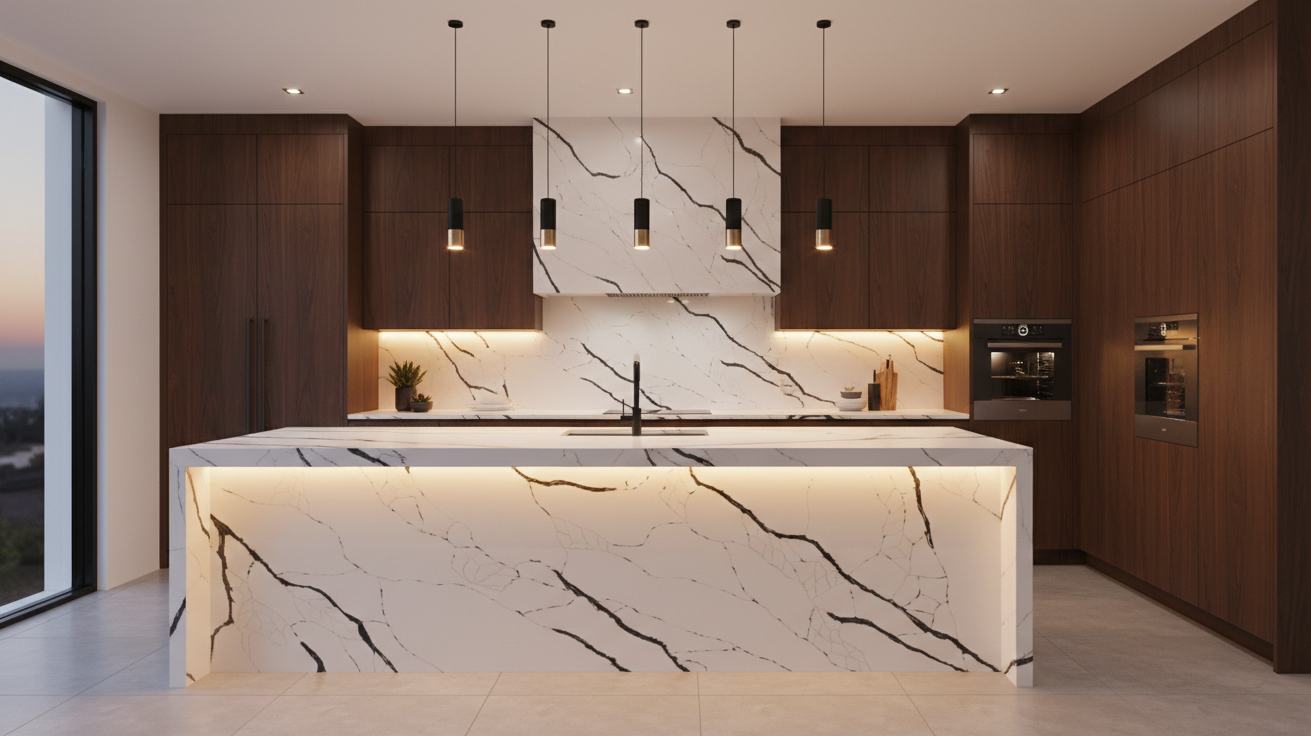
Ideal for sprawling kitchen islands with waterfall edges. The veining continuously rolls over the top surface and drops straight down the side panels, maintaining a flawless, unbroken rhythm.
3. Quad-Matching (Four Slabs)
For grand-scale commercial lobbies or double-height accent walls, architects can stitch four matching slabs together (two up, two down). This creates a massive, kaleidoscope-like centerpiece where all four corners converge at a single intersecting point.
Technical Specifications: The Step-by-Step Blueprint
Executing a flawless installation requires tight communication between the architect, the interior designer, and the fabricator. Misordering steps or failing to check slab alignment can turn a premium concept into a costly visual mess.
Critical Caveats for the Spec Sheet
Before finalizing your construction documents, keep these three structural guardrails in mind:
The UV Warning: Most engineered quartz utilizes resin binders that degrade, yellow, or crack under prolonged exposure to ultraviolet rays. Do not specify bookmatched quartz for outdoor kitchens or sun-drenched exterior cladding unless the manufacturer explicitly certifies it as an outdoor-rated, resin-free material.
-
Slab Thickness Constraints: Bookmatched variations are typically produced in 2cm or 3cm thicknesses. For vertical wall claddings, 2cm is highly preferred to mitigate dead-load weight issues on the wall studs.
-
The "Perfect Seam" Myth: Because quartz patterns are printed or mixed into the aggregate during manufacturing, veins will match up beautifully, but they may not match with 100% micro-precision like a computer graphic. A tolerance of a few millimeters at the seam line is standard across the industry.